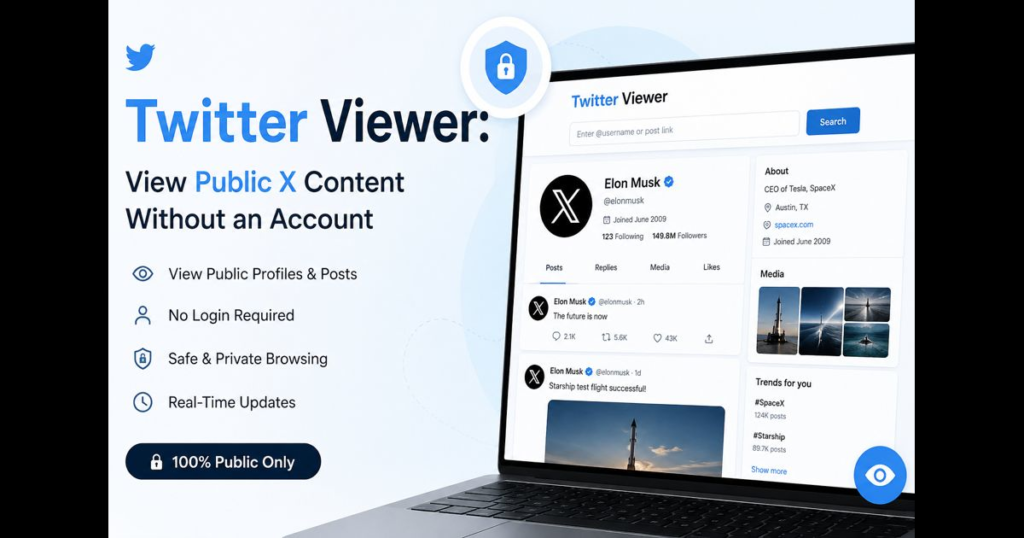
A Twitter viewer is a browser-based service that displays publicly available content from X, formerly Twitter, without requiring the visitor to sign in to an X account. Depending on the service, it may show a public profile, an individual post, recent media, replies, or public engagement counts.
The important boundary is simple: a viewer can only be a convenient way to read information that is already public. It cannot legitimately reveal protected posts, private messages, private likes, or anything limited to approved followers. X states that protected posts are visible only to the account’s followers and do not appear in third-party search engines. X’s privacy guidance is the most reliable reference when a profile does not load.
What a Twitter Viewer Can Show
The exact display varies by service and can change as X adjusts its access rules. A working viewer may provide:
- A public account’s display name, bio, avatar, location, and website link.
- Recent public posts, including individual posts and parts of a thread.
- Public photos, videos, GIFs, links, and hashtags attached to a post.
- Public reply context, where that context is available.
- Visible counts such as replies, reposts, quotes, or likes.
- Basic discovery features, such as a handle lookup, a post URL field, or a public topic feed.
These features are useful for reading public statements, checking a source before citing it, following a live event, or finding the original context around a shared link. They are not a substitute for an authenticated X account when someone needs to follow, reply, bookmark, send messages, or access account-specific material.
What It Cannot Reveal
Clear limits make a viewer more trustworthy, not less useful. A legitimate service cannot provide access to:
- Protected posts or a protected account’s media.
- Direct messages, drafts, or an account’s private lists.
- Posts removed by the author or unavailable because of a platform restriction.
- A private list of another person’s liked posts.
- Content restricted by law, geography, age settings, or the platform’s own enforcement.
Any page that says it can unlock a private account, reveal hidden likes, or bypass a follow request should be avoided. Those claims can lead to phishing, unwanted extensions, misleading paywalls, or malware.
How a Twitter Viewer Typically Works
Most viewers accept one of three inputs: an @handle, a public profile address, or a direct post link. The service then retrieves and formats public information in its own interface. It is best to treat the result as a reading view rather than an official record.
For a reliable check, use this sequence:
- Confirm the account identity from its handle, profile details, and linked website—not only the display name.
- Open the individual post when the wording, date, media, or reply context matters.
- Check the time shown on the post and whether the viewer labels its result as cached.
- Compare consequential information with the official website, statement, filing, or a reputable news report.
- Keep the original X URL with your notes so the source can be revisited later.
Anonymous Browsing and Privacy Are Different Things
“Anonymous” may mean that the service does not ask visitors to create an X account. It does not automatically mean that no information is collected.
Before using a viewer, read its privacy policy and look for a plain explanation of analytics, cookies, advertising, retention, and sharing. Use a service through its normal website rather than downloading an unfamiliar browser extension. A viewer that only reads public pages should not need an X password.
If a service asks to connect an X account, the decision changes. X advises users to review requested permissions and use its OAuth authorization flow rather than giving a third party an X password. Connected applications can request read, write, or direct-message permissions, and their access can be reviewed or revoked in X’s Apps and sessions settings. See X’s guidance on third-party app permissions before authorizing anything.
Why Results May Be Missing, Old, or Incomplete
Viewer results are not guaranteed to match X at every moment. Public access paths, rate limits, caching, deleted posts, account restrictions, and technical outages can all affect what appears. A blank page does not prove that an account has no posts. It may indicate a protected profile, a recently changed privacy setting, a temporary retrieval problem, or data that has not refreshed.
Use these checks before drawing a conclusion:
- Verify that the handle is spelled correctly and has not changed.
- Try the public X URL in a separate browser session.
- Check whether the account was protected, suspended, or deleted.
- Look for a timestamp or cache notice on the viewer.
- Avoid treating a missing reply, media file, or old count as proof of removal.
If the difficulty is specific to Sotwe, the site’s guide to common Sotwe issues and fixes covers typical loading and access problems. For a basic walkthrough of public-profile browsing, see how to use Sotwe to view public profiles.
Public Content Still Deserves Care
Public availability is not a blank permission slip. A post can be public and still be copyrighted, personal, misleading when cropped, or inappropriate to redistribute. Downloading a video does not transfer ownership. Reposting a screenshot without its date, source, or surrounding context can mislead readers.
Good practice is straightforward:
- Attribute the creator when quoting or embedding public material.
- Preserve the post link and date with any screenshot or saved media.
- Check the original account before treating a post as authentic.
- Do not use a viewer to collect sensitive personal details or target someone for harassment.
- Respect a creator’s rights and any applicable platform rules before republishing media.
For reporting, research, or business monitoring, collect the minimum public context needed and corroborate claims elsewhere. A public post can show what an account said; it does not by itself establish that the claim is true.
Choosing a Viewer Carefully
Instead of choosing a service because it makes the boldest promise, assess it with a short checklist:
|
Check |
Why it matters |
|
Public-only boundary |
A credible service explains that protected accounts remain unavailable. |
|
No password request |
A read-only viewer should not ask for X credentials. |
|
Clear privacy policy |
It should explain cookie use, collection, retention, and sharing. |
|
Visible limitations |
Honest notes about caching, unavailable posts, or rate limits are useful signals. |
|
Simple web access |
Avoid unnecessary downloads, extensions, and notification permissions. |
|
Source preservation |
Direct public X links make it easier to verify information later. |
For a broader look at the trade-offs between lightweight viewers and more comprehensive social-monitoring products, read Sotwe vs. other social viewers.
A Better Way to Use Public X Information
A Twitter viewer is most useful when it reduces friction without reducing judgment. Use it to locate a public profile, read a linked post, examine the complete thread, and preserve context. Then stop at the boundary between public information and private access.
That boundary protects the account holder, protects the reader from deceptive services, and makes the information more reliable. The best viewer is not the one that claims to expose everything; it is the one that helps visitors understand public content clearly, safely, and with its limits intact.
Frequently Asked Questions
Can a Twitter viewer show a private account?
No. Protected posts are intended for approved followers. A legitimate viewer should not claim to bypass that setting.
Can I view public X posts without an account?
Some browser-based viewers offer access to public profiles and posts without requiring an X login. Availability can change, and individual results may be limited or cached.
Is it safe to use a Twitter viewer?
It can be safer when it is used only for public information, has a clear privacy policy, does not require a download, and never asks for your X password. If an account connection is necessary, review the permissions through X’s authorization screen.
Why can’t I see a profile or post?
The account may be protected, suspended, deleted, regionally restricted, misspelled, or temporarily unavailable through the viewer. Cached data and platform-side changes can also affect results.
Can I reuse a public post’s image or video?
Public visibility does not automatically grant reuse rights. Keep attribution and source context, and obtain permission when the intended use requires it.